Reimagining Global AI Literacies
Reimagining the Global AI Literacies Framework
by Saran Jolly and Erik Jon Byker, Ph.D.
Article written by Saran Jolly and Erik Jon Byker, Ph.D.
APA Citation for this article: Jolly, S. & Byker, E.J. (2026). Reimagining the global AI literacies framework, 2nd ed. GREET Center. https://greetcenter.charlotte.edu/reimagining-global-ai-literacies/
Note: The Global AI Literacies framework first emerged from Dr. Erik Jon Byker’s (2025) writing on the intersection of global literacies and Artificial Intelligence. As part of his research in the Global-ready Research Center (known as the GREET Center), Dr. Byker developed the contours for the Global AI Literacies framework and provided an illustrative model for that framework. That original article can be found here on the GREET website. Through dialogue and discussion with Saran Jolly, the Global AI Literacies Research Specialist in the GREET Center, the original Global AI Literacies framework has been reimagined to provide further clarity on the features and vocabulary within the Framework. This article is representative of that reimagining of the Global AI Literacies Framework (Byker, 2025, 2026; Jolly & Byker, 2026a). This is the second edition of this article. The first edition can be found in the articles section of GREET LinkedIn account.
Abstract
Artificial Intelligence (AI) is here and in the everyday infrastructure of how leaders communicate, learn, and create. Yet, in higher education and global learning contexts, AI can be reduced to either a tool for efficiency or a threat to academic integrity. Working together at the GREET Center, we have discussed and recognized a need for a reimagined framework to support our mission of developing leaders and educators with Global AI Literacies.
Keywords: artificial intelligence, Critical Cosmopolitan Theory, global AI literacies, global-ready research, Jagriti Cycle, technological play theory
Byker (2025, 2026) first wrote about the need for a Global AI Literacies framework that was informed by Critical Cosmopolitan Theory (Byker, 2013, 2016) and Technological Play Theory (Byker, 2017). We define Global AI Literacies as the “critical engagement and ethical use of artificial intelligence (AI) for reading the world to expand learning globally in sustainable ways” (Byker & Jolly, 2026, para. 3). Through collaborative discussion and work-shopping, we created an initial figure for the Global AI Literacies Framework. By integrating insights from Jolly’s (2025, 2026) work on the Jagriti Cycle, we refined our Global AI Literacies figure (see Figure 1 below). We included updates to the core conceptual features and to the visual design for greater accessibility. Here is a look inside the key improvements made to give the Global AI Literacies Framework a deeper, more dynamic orientation.
Figure 1
Global AI Literacies Framework (reimagined)

Refining the Global AI Literacies Framework through Key Conceptual Upgrades
Literacies are not static, technical skills; they are plural, sociocultural practices through which human beings negotiate meaning, agency, and power (Byker, 2012; Byker & Jolly, 2026). To capture this dynamism, we proposed four critical updates to the framework’s features:
Grounding AI in “Nested Sustainability”
In early discussions, we treated sustainability as a standalone environmental check-box. However, we have upgraded the Global AI Literacies framework with a nested mindset encompassing three dimensions:
- Environmental Impact: Generative AI relies on heavy computational infrastructure that consumes vast amounts of electrical power, clean water for server cooling, and rare-earth minerals. Global AI Literacies means weighing these ecological costs before deploying automated solutions.
- Economic Impact: Global AI Literacies also means auditing AI adoption to ensure equitable resource allocation and being conscious of digital extraction from overwhelming local economies.
- Social Impact: Algorithms must be critically evaluated to protect human dignity, foster community empowerment, preserve diverse worldviews, and mitigate algorithmic bias.
Because these three dimensions are nested, a choice that benefits economic gain at the expense of social equity or planetary health fails to expand learning in sustainable ways.
Shifting from “Ethical Governance” to “Ethical Stewardship”
While “governance” can sound top-down or legalistic, we adopted the language of ethical stewardship for reimagining our Global AI Literacies framework. We contend that such stewardship includes the CARE Principles for Indigenous Data Governance (Collective Benefit, Authority to Control, Responsibility, and Ethics), ethical stewardship treats data, cultural knowledge, and AI models as shared assets to be safeguarded rather than commodities to be exploited.
Elevating “Conscious Creativity”
Another feature of the Global AI Literacies we updated relates to the inclusion of creativity. We introduced the feature of “conscious creativity” to ensure that human reflection remains at the heart of the creative process. Conscious creativity treats AI as a collaborative partner rather than a shortcut. It urges creators to ask Freirean questions during the act of making: Whose voices and styles are represented? Who is missing? What are the ecological costs of generating this media, and how does it open eyes to the world and to global issues?
Deepening the Definition of “Technological Play”
In our updated Global AI Literacies framework, we expanded Technological Play to mean a deliberate, critical space where learners test prompt limits and discover what an AI tool can and cannot do. Through curious play, users transition from passive consumers into active co-auditors who critically examine hallucinated data and algorithmic bias.
Connecting to the Jagriti Cycle: Learn, Unlearn, Relearn
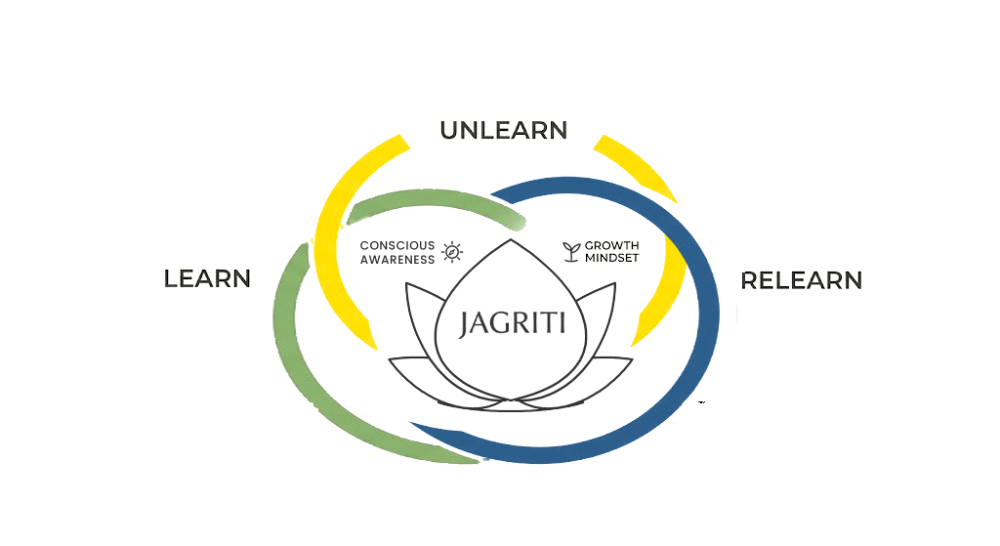
A central contribution to this updated framework is its alignment with the Jagriti Cycle (Jolly, 2025, 2026; Byker & Jolly, 2026), a conceptual model centered on the transformative process of learning, unlearning, and relearning. The synergy between the Jagriti Cycle and Global AI Literacies operates in three ways:
- LEARN through Technological Play: Learners approach generative AI with childlike curiosity, freely testing ideas and exploring technological possibilities.
- UNLEARN through Conscious Awareness & Critique: As users engage critically, they unlearn inherited biases, interrogate possible data hallucinations, challenge algorithmic assumptions, and are aware of the nested sustainability impact.
- RELEARN through Purposeful Action: Equipped with ethical stewardship and civic competencies, scholars and leaders relearn how to co-create sustainable, human-centered digital futures.
Through this cycle, educators and learners can transform into “lightkeepers” (Jolly, 2025) who lead in bringing clarity, ethical purpose, and critical consciousness to the uses for AI. See Figure 2 below for the Jagriti Cycle.
Figure 2
The Jagriti Cycle
Redesigning for Accessibility: The Yellow Sun at the Core
To complement these conceptual refinements, we reimagined the graphical representation of the Global AI Literacies Framework to make it visually intuitive, accessible, and balanced. This includes:
- Clear Structural Contrast: Outer contours—Nested Sustainability, Ethical Stewardship, Civic Competencies, Conscious Creativity, and Technological Play—are encased in distinct, color-coded nodes connected by vibrant lines representing the action oriented features of Global AI Literacies.
- The Central Yellow Circle: The center hub features a yellow circle, symbolic of the sun, which serves as anchoring source of illumination related to Freire’s (1970) notions of reading and re-writing the world.
- Orienting the Contours: Indeed, the central sun houses the core mission of Global AI Literacies: “Reading the world” and “Re-writing the world”. It visually signals that all five outer features are grounded in and illuminated by critical consciousness.
Practical Applications of the Global AI Literacies Framework
To translate theory into practice, the updated Global AI Literacies Framework provides some concrete directions across disciplines and leadership roles. The examples below are a sampling of connections that could be made to the Framework. There are other applications to each subject area, which would incorporate additional connections to the outer contours of the Framework. The examples and applications aren’t definitive but, rather, strong ideas of how these subject areas incorporate the Framework in their unique ways:
Applications by Subject Area
- Humanities & Arts: Applying Conscious Creativity to examine cultural representation in AI-generated imagery and narrative writing while investigating whose artistic styles are embedded in model training sets.
- STEM & Computer Science: Incorporating Nested Sustainability and Ethical Stewardship to audit server carbon footprints, model power consumption, and build algorithms aligned with CARE data principles.
- Social Sciences & Global Studies: Leveraging Civic Competencies to explore how AI tools impact global equity, influence public discourse, and facilitate international exchange through Globally Networked Learning (Byker & Sadula, 2023).
- Education & Pedagogy: Employing Technological Play to structure classroom prompt-auditing exercises where students identify hallucinated data and debate algorithmic biases.
Applications for Key Stakeholders
- For Learners and Educators: Shifts students and teachers from passive tech consumers into active co-creators who play with tools, evaluate outputs critically, and know when to use AI to address community issues.
- For Scholars & Researchers: Establishes inquiry frameworks to measure the digital carbon footprint of campus AI models, evaluate algorithmic extraction, and conduct ethical research with AI.
Reimagining the Global AI Literacies Framework has been a rewarding collaboration at the GREET Center. As AI continues to reshape higher education, our goal is to ensure that technology serves human dignity, a sustainable balance, and global awareness.
💡 How is your institution or organization approaching ethical AI adoption, sustainability, and creative agency? Please share your thoughts and experiences in the comments below!
References
Byker, E. J. (2012). The Bangalore challenge: Case studies of the social construction of technology in elementary schools. [Doctoral dissertation, Michigan State University]. ProQuest Dissertations and Theses Global.
Byker, E. J. (2013). Critical cosmopolitanism: Engaging students in global citizenship competencies. English in Texas Journal, 43(2), 18-22.
Byker, E. J. (2016). Developing global citizenship consciousness: Case studies of critical cosmopolitan theory. Journal of Research in Curriculum and Instruction, 20(3), 264–275.
Byker, E. J. (2017). I play I learn: Introducing Technological Play Theory. In C. Martin & D. Polly (Eds.), Handbook of research on teacher education (pp. 297–314). IGI Global.
Byker, E. J. (2025). Global education and global ready learning. In C. O’Brien, E. J. Byker, A. Good, & A. Myers (2nd ed), Foundations of education and diversity in American schools (Chapter 7). Kendall Hunt Publishing Company
Byker, E.J. (2026). Global AI literacies framework: reading, re-writing, and sustaining the world. GREET Center.
Byker, E. J., & Jolly, S. (2026). Building global AI literacies through the critical skills of learning, unlearning, and relearning [Conference presentation]. KrupaDecon 2026, Bengaluru, India.
Byker, E. J., & Sadula, M. (2022). Mainstreaming the sustainable development goals: Advancing global citizenship education through the SDGs. Journal of Global Citizenship Education, 2(1), 1–4.
Freire, P. (1970). Pedagogy of the oppressed. Basic Books.
Global Indigenous Data Alliance. (2019). CARE principles for Indigenous data governance. GIDA.
Jolly, S. (2025, November 18). Lightkeepers [TEDx talk]. TEDxCraverRoad Countdown.
Jolly, S. (2026, November 16). The Jagriti Cycle. [TEDx talk]. TEDxUNC Charlotte Salon.
Jolly, S. & Byker, E.J. (2026). Reimagining the global AI literacies framework. (1st ed.). GREET Center LinkedIn Article.