Global AI Literacies Framework
Global AI Literacies Framework: Reading, Re-Writing, and Sustaining the World
Erik Jon Byker, Ph.D. (Founder of the Global-ready Research Center)
How to cite this article:
Byker, E.J. (2026). Global AI literacies framework: reading re-writing, and sustaining the world. GREET Center.
Abstract
As the uses for artificial intelligence (AI) continues to shape educational landscapes, higher education must be ready to prepare learners and educators with global-ready skills to navigate AI. The purpose of this article is to examine and discuss the Global AI Literacies Framework. This framework is grounded in Critical Cosmopolitan Theory (Byker, 2013, 2016) and Paulo Freire’s (1970) conceptualization of literacy as reading and re-writing the world. The framework positions Global AI Literacies not merely as technical fluency, but as the critical, ethical, and sustainable engagement with emerging digital technologies. Emphasizing critical consciousness, Indigenous knowledge via the CARE principles, and Technological Play Theory (Byker, 2017), this article details how educators and leaders can cultivate global-ready competencies and skills through AI Literacies. The article also incorporates the Jagriti Cycle of learning, unlearning, and relearning (Jolly, 2025; Byker & Jolly, 2026) while prioritizing long-term digital sustainability. The article concludes with compelling questions for a future research agenda.
Keywords: artificial intelligence (AI), concientization, Critical Cosmopolitan Theory, Global AI Literacies, global-readiness, Jagriti Cycle, Technological Play Theory
Higher education is currently situated in a pivotal place where the uses for artificial intelligence (AI) are expanding with many unexamined consequences. Rather than treating AI as a mere efficiency tool or an academic threat, the Global AI Literacies Framework situates the uses for AI in Critical Cosmopolitan Theory (Byker, 2013, 2016).
Critical Cosmopolitan Theory supports the development of global competencies and global-ready skills towards critical consciousness. Byker (2016) explains how critical consciousness is a person’s ability to critically examine the world, understand how power and inequality impact human experiences, and take informed, ethical action to create more just, sustainable, and equitable communities. Freire (1970) uses the word conscientization to describe critical consciousness and connected the idea to being a literate person who is engaged with reading and re-writing the world. Global AI Literacies builds on the notion of critical consciousness in relation to the uses for artificial intelligence. Byker (2026) first defined Global AI Literacies as: “The critical engagement and ethical uses of artificial intelligence (AI) for reading the world to expand learning globally in sustainable ways” (para. 4).
Why are literacies plural?
Global AI Literacies frame literacies as plural rather than a singular concept. Indeed, reducing literacy to a singular idea is akin to thinking literacy is only about reading books. The idea of plural literacies is the recognition of multiple ways of engaging many kinds of texts including social media, multimedia, print media, etc. Literacies are not static; they are dynamic, sociocultural practices through which human beings negotiate meaning, agency, and power with the tools they use (Byker, 2012).
Sustainability and Ethical Governance
Global AI Literacies Framework includes an emphasis on ecological and digital sustainability. Sustainability is a mindset connected to global awareness and the ability for people in a community to meet its needs without depleting the ability to meet the needs of future generations (Byker & Sadula, 2022). The Global AI Literacies Framework embeds a nested mindset of sustainability centered on three dimensions: the environmental, the social, and the economic. Sustainable AI use requires evaluating AI uses and applications through a lens of critical consciousness in all three nested dimensions, which includes examining the:
- Environmental Impact: Generative AI relies on heavy computational infrastructure that consumes vast amounts of electrical power, clean water for server cooling, and rare-earth minerals.
- Economic Impact: AI adoption must be audited to ensure equitable resource allocation, preventing monopolies and digital extraction from overwhelming local economies.
- Social Impact: Algorithms must be interrogated for cultural representation, human dignity, community empowerment, and the prevention of algorithmic bias.
Using this nested understanding of sustainability, educators, learners,and leaders can interrogate sustainable AI use by asking key questions:
- Environmental: What is the ecological footprint (energy, water, carbon emission) of generating this AI output, and is an AI-driven solution genuinely necessary for this task?
- Economic: Who financially benefits from this AI tool’s deployment, and does it build sustainable local capacity or extract resources for corporate gain?
- Social: Whose languages, worldviews, and cultural knowledge are sustained or erased by this model, and how does its use impact human agency and social equity?
This nested sustainability directly reinforces the framework’s commitment to ethical governance, anchored in the CARE Principles for Indigenous Data Governance (Global Indigenous Data Alliance, 2019):
- Collective Benefit: AI tools must empower local communities rather than extract cultural data for corporate profit.
- Authority to Control: Communities retain sovereign authority over their data and cultural knowledge.
- Responsibility & Ethics: Developers and educators bear an ethical duty to prevent harm, safeguard human dignity, and honor diverse worldviews.
Contours of the Global AI Literacies Framework
.The Global AI Literacies framework was also informed by the features of Technological Play Theory (TPT) (Byker, 2017). TPT posits that curiosity is central to learning and it is activated by freedom. In AI-rich environments, play unlocks spaces for possibility and malleability, enabling learners to critically examine and creatively co-author AI outputs. The exploration of AI through curiosity and even play is part of Freire’s (1970) mandate of reading and re-writing the world. Yet, reading the world involves also critically examining AI to identify algorithmic bias, hallucinated data, and the impact on the nested dimensions of sustainability. Re-writing the world transforms critique into agency by giving power and voice to learners to collaborate on ways to take action on global issues.
In describing the Global AI Literacies framework it is important to acknowledge how the contours of this framework are multi-faceted and deeply interconnected. The contours include: sustainability, technological play, ethical governance, civic skills, and
Figure 1 shows a graphical representation of the contours of Global AI Literacies Framework.
Figure 1
Global AI Literacies Framework
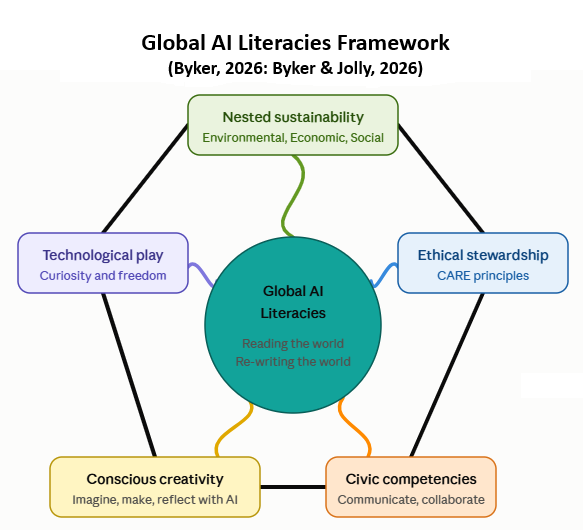
As Figure 1 illustrates, the Global AI Literacies Framework is a dynamic model made up of many features. Each feature of the framework answers a different part of the definition for Global AI Literacies: “the critical engagement and ethical uses of artificial intelligence (AI) for reading the world to expand learning globally in sustainable ways” (Byker & Jolly, 2026, para. 3). Taken together, the five features show how the contours of the definition and how it is applied in practice.
Technological play
Technological Play Theory holds that curiosity is at the core of learning and that freedom activates it (Byker, 2017). In AI-rich environments, play opens spaces of possibility and malleability. Learners test prompts, push against the limits of a tool, and see what it can and cannot do. This is how they audit and co-author AI outputs instead of simply accepting them. Play does not mean being uncritical, though. It has to be framed by critical consciousness, so that exploration leads to evaluation.
Nested sustainability
In the context of Global AI Literacies, nested sustainability means examining the AI’s impact on the environment, the economy, and the social aspects of an AI tool. Environmentally, generative AI demands large amounts of electricity, clean water for cooling servers, and rare earth materials, so a literate user weighs these costs before deciding when and why to use the technology. Economically, the question is who profits from AI and who bears its burdens, including whether communities are empowered or whether their cultural data is extracted for corporate gain. Socially, it asks whether AI use supports human dignity, equity, and well-being across generations and cultures. The word “nested” signals that these three dimensions cannot be separated, since a choice that helps one at the expense of another does not expand learning in a lasting way. This is why the definition calls for expanding learning globally “in sustainable ways” (Byker, 2026), and why sustainability is a core feature of the framework rather than an afterthought.
Ethical stewardship
Ethical stewardship means caring for AI, data, and cultural knowledge as a shared trust rather than as property to be owned or exploited. It is grounded in the CARE Principles for Indigenous Data Governance (Global Indigenous Data Alliance, 2019), which call for Collective Benefit, Authority to Control, and Responsibility and Ethics. In practice, it asks educators and developers to adopt and use AI tools in ethical ways. It also respects the knowledge and data privacy of people and communities. It is a commitment for those who build and teach with AI to prevent harm and honor diverse worldviews. Within Global AI Literacies, ethical stewardship is the “ethical uses” in the definition, turning critical engagement into responsible action for current and future generations.
Civic competencies
Civic competencies including communication and collaboration related to how individual critique becomes shared action. They connect to “expand learning globally,” because no one reads the world alone. Civic competencies come directly from Critical Cosmopolitan Theory, which supports global competencies and global-ready skills that move learners toward critical consciousness (Byker, 2013, 2016). They are also why Global AI Literacies is framed as both a technological and a civic competency, since knowing how to use AI is not enough without the ability to work with others. Civic competencies build on technological play and conscious creativity by turning individual exploration and making into shared projects that people can discuss, question, and improve together. They also depend on ethical stewardship and nested sustainability, because collaboration only serves the common good when partners respect whose knowledge is being used and what the work costs the planet and communities. In this way, civic competencies fulfill the definition’s call to expand learning globally (Byker, 2026).
Conscious creativity
Conscious creativity describes creating with AI while staying aware of who is represented, who is missing, and what the work is for. It grows out of Technological Play Theory, which holds that curiosity is the seedbed of learning and that freedom activates it (Byker, 2017), and it asks learners to explore AI as a creative partner rather than a shortcut. With AI, learners can compose music, generate images, draft stories and scripts, build interactive media, prototype designs, and remix ideas in ways that were once out of reach. Conscious creativity means users treat each output as a starting point to question, reflect, revise, and shape. They notice what the tool produced, what it left out, and how their own choices changed the result, which carries Freire’s (1970) idea of reading and re-writing the world into the act of making. Ethical stewardship asks whose knowledge and creative work the tool draws on, and nested sustainability asks what the creation costs the planet and communities. Within Global AI Literacies, this is how learners show they can do more than consume AI: they play, create, and reflect, and so expand what learning entails (Jolly, 2025; Byker & Jolly, 2026).
Connections to the Jagriti Cycle
Global AI Literacies is also shaped, in part, by the Jagriti Cycle (Jolly, 2025; Byker & Jolly, 2026), a conceptual framework based on the process of learning, unlearning, and relearning. By approaching AI with childlike curiosity (learning), dismantling inherited biases (unlearning), and acting with ethical purpose (relearning), scholars and educators can become “lightkeepers” who illuminate equitable digital futures across generations (Jolly, 2025; Byker & Jolly, 2026; Grimes & Byker, 2025). Operationalized through the GREET Center’s professional development curriculum supported by the Longview Foundation, the Global AI Literacies framework is critical to the implementation of international virtual exchanges through Globally Networked Learning (Ade-Thurow & Byker, 2024; Byker et al., 2023; Manzocco et al., 2025).
Compelling Questions for Future Inquiry
To advance the Global AI Literacies Framework, the following questions can guide researchers and practitioners in a future research agenda:
- How can educational institutions measure and minimize the digital carbon footprint of campus-wide AI deployment while maintaining technological access?
- In what ways can the CARE Principles be embedded into generative AI prompting and software design to prevent algorithmic data extraction?
- How do educators move from passive consumption of AI outputs to active Freirean conscientization and social action?
- What pedagogical structures best support intergenerational dialogue between senior faculty and digital-native students when co-auditing AI systems?
- How can Globally Networked Learning (GNL) leverage sustainable AI tools to expand access for underrepresented and first-generation university students?
References
Ade-Thurow, B., & Byker, E. J. (2024). Intercultural exchange for sustainable futures. Journal of Teacher Education and Educators, 13(3), 184–198.
Byker, E. J. (2012). The Bangalore challenge: Case studies of the social construction of technology in elementary schools (Publication No. AAI3524233) [Doctoral dissertation, Michigan State University]. ProQuest Dissertations and Theses Global.
Byker, E. J. (2013). Critical cosmopolitanism: Engaging students in global citizenship competencies. English in Texas, 43(2), 18–22.
Byker, E. J. (2017). I play I learn: Introducing Technological Play Theory. In C. Martin & D. Polly (Eds.), Handbook of research on teacher education (pp. 297–314). IGI Global.
Byker, E. J. (2016). Developing global citizenship consciousness: Case studies of critical cosmopolitan theory. Journal of Research in Curriculum and Instruction, 20(3), 264–275
Byker, E.J. (2025). Global education and global ready learning (Chapter 7). In C. O’Brien, E.J. Byker, A. Good, and A. Myers (Eds.), Foundations of education and diversity in American schools. Kendall Hunt Publishing Company
Byker, E. J., & Jolly, S. (2026). Building global AI literacies through the critical skills of learning, unlearning, and relearning [Conference presentation]. KrupaDecon 2026, Bengaluru, India.
Byker, E. J., & Sadula, M. (2022). Mainstreaming the sustainable development goals: Advancing global citizenship education through the SDGs. .ed Journal of Global Citizenship Education, 2(1), 1–4.
Byker, E. J., Sadula, M., Ade-Thurow, B., & Martin, F. (2023). Equity of international access: Connecting first generation university students to GNL. The Global Impact Exchange Journal, 13(1), 12–18.
Freire, P. (1970). Pedagogy of the oppressed. Basic books.
Global Indigenous Data Alliance. (2019). CARE principles for Indigenous data governance. GIDA.
Grimes, M., & Byker, E. J. (2025). Sparking the flame: Research as inquiry for aspiring educators. Journal of Teacher Education and Educators, 14(3), 201–217.
Jolly, S. (2025, November 18). Lightkeepers. TEDxCraverRoad Countdown talk.
Manzocco, M., Ade-Thurow, B., & Byker, E. J. (2025). Developing critical thinking through AI-powered debate. International Research and Review Journal, 14(2), 47–63.
UNESCO. (2024). AI competency framework for teachers. UNESCO Publishing.