Jagriti Cycle
The Jagriti Cycle: An Introduction for Educators
By Saran Jolly and Erik Jon Byker, Ph.D.
APA Citation – How to cite this article:
Jolly, S. & Byker, E.J. (2026). The Jagriti cycle: an introduction to educators. GREET Center. https://greetcenter.charlotte.edu/jagriti-cycle/
As you prepare to step into the classroom and begin your career as teacher or educator, you will quickly realize that teaching is far more than delivering content. It is an evolving journey of personal and professional transformation. Entering the teaching profession requires navigating the demands of instructional design and state standards, meeting diverse student needs, and reflecting on your educational values.
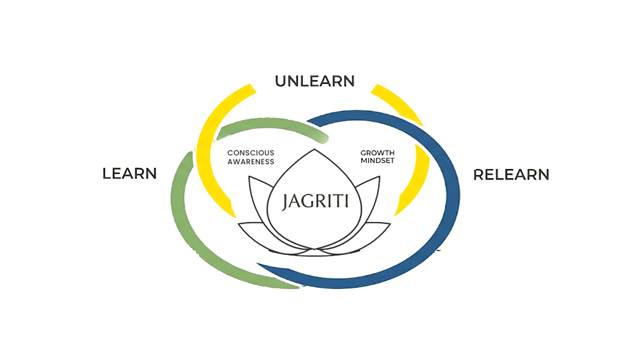
To support your journey, we invite you to explore the Jagriti Cycle, a framework that emerged from a TEDx talk I (Saran) delivered in 2025. Since then, we have co-developed this framework and called it the Jagriti Cycle. We recognize Jagriti as a robust and universal word, which captures the importance of developing conscious awareness through a growth mindset. Through our conversations, we have come to the following working definition: The Jagriti Cycle is a framework of learning, unlearning, and relearning that lights an awakening about the world. The framework is anchored in conscious awareness to address ignorance and a growth mindset to support active engagement with the world.
See Figure 1 below for a illustrative example of the Jagriti Cycle.
Figure 1
The Jagriti Cycle
Context
In the first TEDx talk I gave, I was inspired by the futurist Alvin Toffler’s declaration that the illiterate of the twenty-first century will be those who cannot learn, unlearn, and relearn. The Jagriti Cycle offers future teachers a practical compass for personal growth, empathy, and conscious awareness in school communities.
At its heart, the Jagriti Cycle is about three simple but meaningful ideas. Learning is being curious enough to welcome something new. Unlearning is being humble enough to question what we think we already know. Relearning is being open to building a perspective that might look entirely different from where we started. But what does this mean for teacher candidates and educators? We offer a couple of points:
Deconstructing the Three Dimensions of the Jagriti Cycle for Educators
For teacher candidates, the three dimensions of the Jagriti Cycle provide a structured pathway to cultivate a growth mindset and move off pedagogical autopilot.
Learning: Curiosity and Empathy
Learning begins with a quest for stories and unyielding curiosity. In schools, learning extends beyond mastering curriculum standards. It requires means connecting with student experiences with deep empathy. When educators approach classrooms with curiosity, they recognize that every student brings a unique narrative shaped by background and personal challenges. By adopting a growth mindset, teacher candidates treat initial ignorance not as a deficit, but as a starting point for discovery, transforming classrooms into spaces of shared exploration.
Unlearning: Humility and Critical Consciousness
Unlearning is often the most challenging yet vital phase for future teachers. It demands the humility to examine inherited presumptions about how school should work and to dismantle subconscious biases regarding student capabilities. Educators must be able to step back and ask: *What assumptions am I making about this student’s potential?* Unlearning requires stepping off autopilot to tear veils of ignorance concealing systemic inequities and cultural misunderstandings. It is not a cynical rejection of educational traditions, but a careful, constructive re-examination of practices that no longer serve students.
Relearning: Openness and Shared Humanity
Relearning represents the active integration of newly unlearned insights into daily classroom practice. It occurs when teachers intentionally re-architect instruction around human connection and responsiveness. Relearning allows educators to transcend narrow agendas and replace dogmatic approaches with authentic relationships. Ultimately, relearning brings teachers to a profound realization: beneath all demographic, linguistic, and socioeconomic differences, every learner is simply a fellow human being deserving of dignity and care.
Framework Origins and Practical Applications
The Jagriti Cycle emerged from a collaborative dialogue between an undergraduate researcher and a faculty mentor. Originating during reflections on global scholarship and student transitions, our dialogue demonstrated that educational growth happens when academic hierarchies are dismantled in favor of reciprocal learning. Just as faculty and students must share equal dialogue, teachers and students thrive when classrooms operate as reciprocal communities of inquiry.
Table 1 illustrates how the Jagriti Cycle converts theory into practice, consider the shift from traditional paradigms to a Jagriti Cycle aligned framework.
Table 1
Traditional Classroom Mindset v. Jagriti Cycle Mindset
| Dimension | Traditional Classroom Mindset | Jagriti Cycle Mindset |
| Learning | Passive accumulation of curriculum content and metrics. | Active, curious engagement with student narratives and open inquiry. |
| Unlearning | Reliance on rigid routines, fixed expectations, and biases. | Conscious questioning of pedagogical assumptions and institutional barriers. |
| Relearning | Enforcing uniform compliance and top-down management. | Co-creating inclusive spaces grounded in empathy and shared humanity. |
By applying this framework, teacher candidates learn that educational challenges are rarely solved by rigid rules. When teachers encounter difficult dynamics, the Jagriti Cycle encourages them to ask:
- What do I need to learn about this student’s reality?
- What expectations do I need to unlearn?
- How can we relearn together?*
The Educator as a Lifelong Learner
The Jagriti Cycle is not a static checklist; it is a recursive, lifelong commitment to growth. As you begin your career as a teacher, you will face moments of uncertainty and change. Embracing a growth mindset allows you to view mistakes and unexpected outcomes not as failures, but as essential opportunities to adapt, refine, and deepen your practice.
By committing continuous learning, courageous unlearning, and intentional relearning, teacher candidates become true lightkeepers in their schools, who harvest light during times of difficulty, foster spaces of belonging, and inspire students on their journey of conscious awareness. As you enter teaching, remember that education is not about perfection, but the continuous awakening of our shared humanity.